
By Edwin Mauluka
Minister of Finance, Economic Planning and Decentralisation Joseph Mwanamvekha has faulted the former Malawi Congress Party (MCP) administration for what he described as the poor implementation of the 2025/2026 national budget.
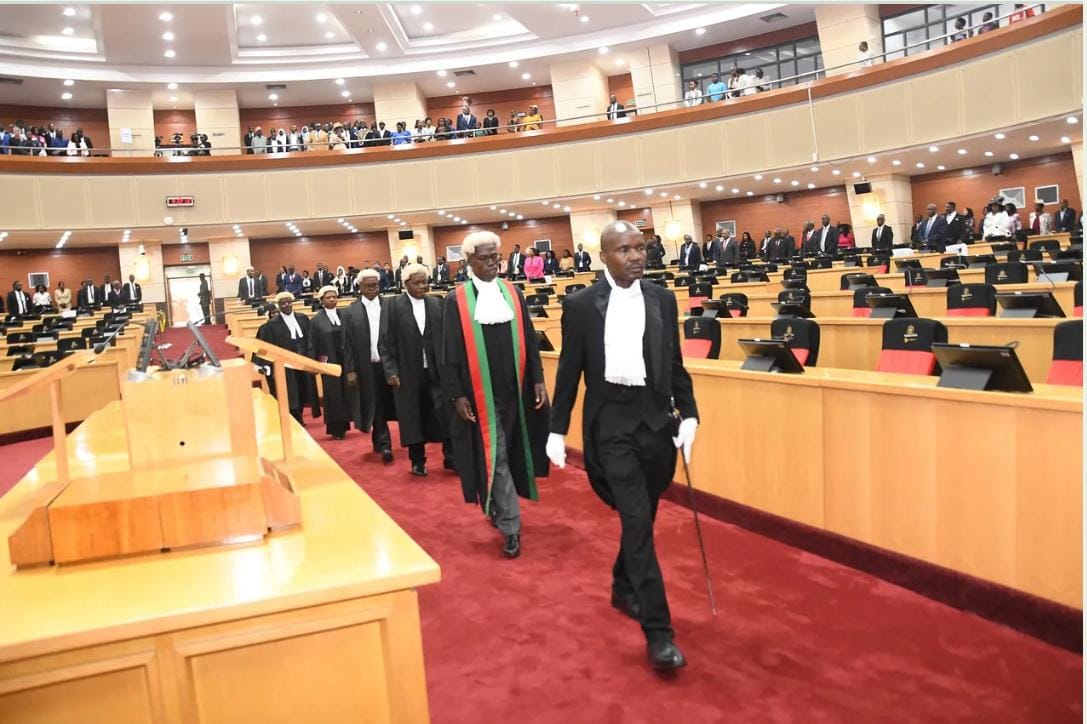
Mwanamvekha made the remarks in Parliament on Friday when presenting the 2025–26 Mid-Year Budget Statement. The first half of the financial year was overseen by the MCP government under former president Lazarus Chakwera.
Presenting the mid-year performance, Mwanamvekha said implementation of the budget was “below par, with persistent revenue underperformance, cost overruns, an unsustainable deficit and high public debt service.”
He highlighted a K281.8 billion overrun in recurrent expenditure (an 8.8 percent increase) driven by wages and salaries, pensions and gratuities, interest payments, and use of goods and services.
Generic goods and services alone registered expenditure of K489.7 billion, representing 71 percent utilisation of the approved allocation. The minister said the biggest contributors to overruns under this budget line were:
- State Residences (over 100%)
- Office of the President and Cabinet (100%)
- Office of the Vice President (94%)
- Ministry of Lands (94%)
- National Registration Bureau (81%)
On wages and salaries, Mwanamvekha attributed the K125.9 billion overspend (19 percent above the K661.5 billion mid-year target) to what he called “massive recruitments” in security agencies, the education and health sectors, and a 100 percent increase in chiefs’ honoraria implemented under the previous administration.
The minister said total approved revenue and grants for 2025–26 amount to K5.578 trillion. However, the first half of the year registered weak performance due to macroeconomic imbalances and a reduction in external grants caused by slow progress on key projects.
Domestic revenue also underperformed, largely because tax revenue fell following reduced import volumes amid foreign exchange shortages. Non-tax revenue, however, exceeded projections by 22.6 percent.
He added that grants underperformed by 43 percent, while total expenditure recorded an overrun of K175.7 billion — 4.1 percent above the approved level.
“This was due to the frontloading of certain expenditure lines in the agriculture, education and health sectors, and over-expenditure on wages and salaries, public debt interest, general elections and domestically financed projects,” Mwanamvekha explained.
On the fiscal deficit, he reported that the first-half deficit stood at K2.037 trillion, compared to a projection of K1.534 trillion, that is, widening by K503.5 billion, or 32.8 percent.
“This deficit is the result of lower-than-anticipated revenue collection coupled with higher-than-planned expenditures during the period under review,” said the minister.