
NEWS | Local Government| Fiscal Decentralisation | Edwin Mauluka
Malawi’s local councils are struggling to fulfil their constitutional mandate because of persistent funding shortfalls, according to a new analysis by the Malawi Local Government Authorities Association (MALGA).
The findings, published in MALGA’s Fourth Quarter Fiscal Space Analysis for the 2025/26 financial year, show that local government authorities (LGAs) received significantly less funding than budgeted during the first quarter of 2026, undermining service delivery and delaying critical development projects.
Development budgets received just 44% of the required funding, while recurrent budgets recorded a 31% shortfall. Overall, councils received MWK36.8 billion during the quarter, leaving a funding gap of MWK8.8 billion.
According to the report, delayed and uneven disbursement of funds disrupted the implementation of several projects, including road rehabilitation and the procurement of teaching and learning materials.
“Rehabilitation of roads stalled because funds meant for road rehabilitation amounting to MWK4.6 billion were not transferred during the period under review,” the report states.
The education sector was also severely affected after failing to receive MWK6.1 billion in planned funding.
“This heavily affected School Improvement Grants and the procurement of teaching and learning materials, limiting schools’ ability to undertake essential improvement activities and reducing the availability of critical resources needed to improve learner outcomes,” the report says.
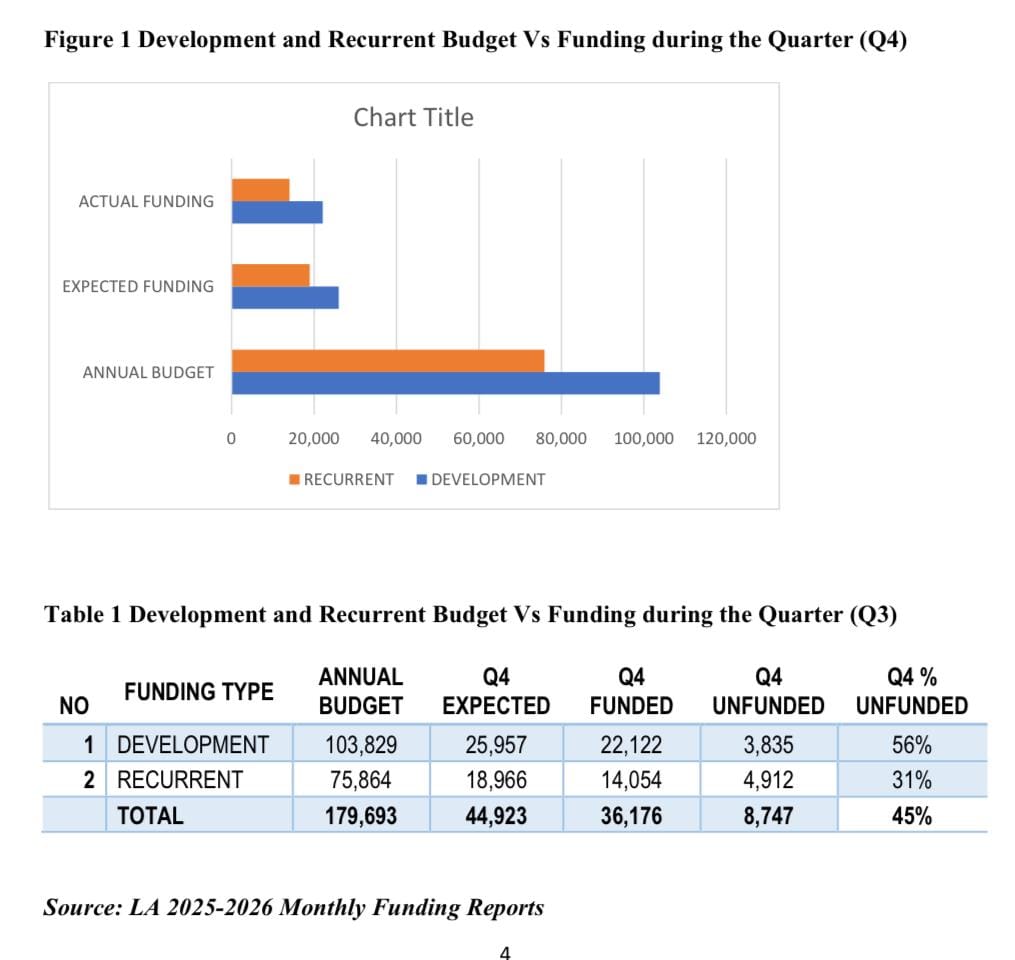
MALGA further noted that several key development funding windows — including the Infrastructure Development Fund (IDF), Borehole Funds and Hospital Rehabilitation Fund — received no funding during the quarter.
“It should be noted that 60% of local authorities’ budgets are allocated to development initiatives. The delayed release of MWK5.3 billion therefore affected the timely implementation of these projects,” the report says.
Malawi’s fiscal decentralisation framework is anchored in Section 150 of the Constitution, the Local Government Act and the Revised National Decentralisation Policy (2024), which requires the government to allocate at least 5% of Net National Revenue (NNR) to councils to support devolved functions.
However, councils received only 4% of NNR during the 2025/26 financial year.
“That was approximately 82% of the constitutionally guided threshold. This indicates a persistent vertical fiscal gap between policy commitments and actual fiscal allocations,” the report notes.
The Fiscal Space Analysis tracks Central Government Transfers (CGTs) to local authorities, covering both Other Recurrent Transactions (ORT) and development funding. It assesses budget credibility, funding adequacy, expenditure performance and sectoral implementation, while highlighting the impact of funding gaps on local governance and service delivery.
The report also points to weak locally generated revenue as another major challenge, blaming the country’s difficult macroeconomic environment, which has constrained business activity and reduced councils’ revenue base.
“Although most LGAs have developed Local Revenue Strategic Plans, implementation has proved difficult. Collecting additional revenue under the current economic conditions is like milking a thin cow,” the report says.
It argues that the weak performance of local revenue collection places an even greater responsibility on the central government to adequately finance devolved functions.
MALGA has urged controlling officers in councils to adopt more innovative and efficient revenue collection strategies to reduce dependence on Central Government Transfers. It identified forestry fees, building plan scrutiny fees, housing rentals, car parking charges and property rates as potential sources of increased local revenue.
The association also called on the Ministry of Finance, Economic Planning and Decentralisation to ensure timely and adequate funding to strengthen councils’ fiscal autonomy.
The report comes as Malawi enters what the government has described as a new phase of fiscal devolution following the allocation of a record MWK1.145 trillion to councils in the 2026/27 financial year. The allocation represents 33.7% of the national budget and includes MWK5 billion for development projects in each constituency.
The increased allocation is expected to strengthen local service delivery, but the MALGA report warns that without timely and predictable disbursements, higher budget allocations alone may not translate into improved outcomes on the ground.
—
Also Read: Government orders local councils to digitalise revenue collection by end of financial year
Related: Malawi DPP government reforms CDF, empowers local councils with K5 billion