
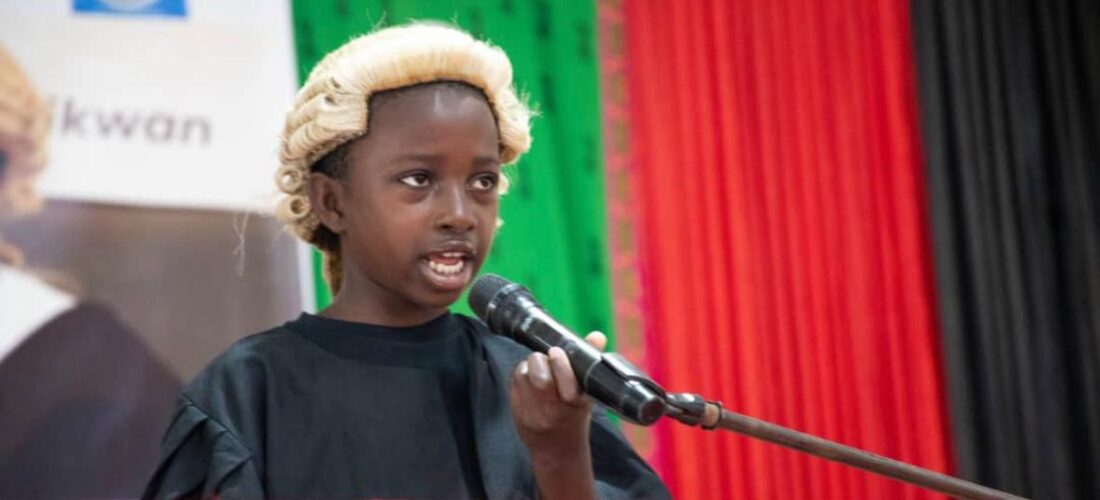
Children speaking at Mchinji District’s first Children’s Parliament say poverty, cultural practices and weak enforcement are pushing girls into marriage before they finish school.
NEWS | Child Rights | Mchinji | By Watipaso Mzungu
School-going children transformed into “honourable members” at the first session of the Mchinji District Children’s Parliament turned their attention to one issue above all others: child marriage.
Held from 3rd to 4th September 2026 at Mchinji Teachers’ Training College, the two-day sitting brought together 165 learners representing Traditional Authorities (TAs) Simphasi, Mkanda, Mavwere, Kapondo, Nyoka, Mduwa and Zulu, each represented as a “constituency”.
The young parliamentarians were tasked with identifying and analysing issues affecting children in their communities. After deliberations, they prioritised five motions: education challenges, access to clean water, health challenges, poor roads and the increasing cases of child marriage.
But it was the motion on child marriage that generated the strongest emotions.
For many of the girls who spoke, early marriage was not an abstract statistic. It was the reality of friends, sisters and classmates who had dropped out of school.
“Girls are being forced to marry at 13, 14, 15 years old,” one child parliamentarian said. “Their future is being sold for goats, money and food. They are becoming wives and mothers before they finish primary school.”
The children linked child marriage to many of the other challenges they had debated.
They said girls who marry early are forced to drop out of school, worsening education challenges in Mchinji, where overcrowded classrooms and shortages of learning materials already affect pupils.
Every girl married off, they argued, represents one fewer potential teacher, nurse or community leader.
The parliamentarians also raised concerns about teenage pregnancy and early childbirth, saying these place additional pressure on already stretched health facilities.
Young mothers face increased risks of pregnancy and childbirth complications, while babies born to adolescent mothers face heightened risks of poor health and malnutrition.
The children also linked child marriage to poverty and poor infrastructure.
“Marriage is for adults, not for children. Let us finish school first.”
With poor roads making it difficult for rural families to access markets and essential services, they said some households see marrying off daughters as a way of reducing the financial burden at home.
But the children argued that the practice only perpetuates poverty from one generation to the next.
Although the full resolutions of the Children’s Parliament are yet to be published, the young lawmakers agreed that ending child marriage requires a collective response involving parents, traditional leaders, teachers, police and government.
They called for stricter enforcement of laws against those who facilitate child marriages, community sensitisation led by chiefs and religious leaders, and greater support for girls to remain in school.
Among their proposed interventions were access to sanitary pads, school feeding programmes and scholarships, as well as safe reporting mechanisms through which children can report cases of abuse and child marriage in their communities.
“Marriage is for adults, not for children,” declared Deborah Ezekiel, Speaker of the Mchinji Children’s Parliament. “Let us finish school first.”
Mchinji, a border district, faces particular pressures linked to poverty, cross-border movement and entrenched cultural practices. Despite Malawi’s legal minimum age of marriage being 18, child marriage remains a concern in the district.
The children said waiting for adults to solve the problem was no longer an option.
“We are the ones affected,” said a boy parliamentarian from TA Mkanda. “If we don’t speak now, who will speak for the girls who are already in marriages?”
Save the Children International (SCI) Senior Advocacy, Campaigns, Communications and Media Manager John Chipeta said his organisation and partners under the Joining Forces Alliance (JOFA) would analyse the resolutions and facilitate discussions to identify issues that individual organisations and government could take forward.
Chipeta said the resolutions would be presented to the District Council, traditional leaders and relevant ministries to help influence policies and programmes.
“Child parliament is the responsibility of every organisation, led by government, and NGOs have a role to support and complement,” he said.
“When we act on what children tell us, we demonstrate their voices matter.”
“Our role is to support and complement the government. Therefore, the issues that children have raised and are being consulted as resolutions may not be targeting the government alone. Some of the issues are targeting us.”
Chipeta said Save the Children had a mandate to respond to some of the concerns from a child-rights perspective, while also working with the government to strengthen systems and improve responses at different levels.
“As Save the Children, as an organisation, we have a mandate in terms of responding to some of these issues from a rights point of view, but also ensuring that we can work with the government in terms of strengthening systems and ensuring that we are responding appropriately at every level,” he said.
In his remarks, Oliver Kumbambe, Principal Secretary for Administration in the Ministry of Gender, Community Development and Social Welfare, congratulated the 165 child parliamentarians, saying their participation demonstrated that children are citizens with rights, views, ideas and aspirations that must be heard and respected.
He said the Children’s Parliament provides a platform for children to learn about their rights and responsibilities, express their views, identify challenges affecting them and propose solutions.
“When we listen to children, we gain a better understanding of the realities they face. When children are given an opportunity to speak, we strengthen democracy. And when we act on what children tell us, we demonstrate that their voices truly matter,” Kumbambe said.
He challenged the young parliamentarians to return to their communities as ambassadors against child marriage, violence, abuse, child labour and exploitation.
Kumbambe also urged parents, guardians and community leaders to create spaces where children can speak freely and safely, while calling on traditional leaders to continue leading efforts to end harmful practices.
—
In the photo above by Watipaso Mzungu, a child parliamentarian addresses fellow members.

